Maths Olympiad Prep

Library / /138 of 426

Geometry Difficulty 5.3 AIME, harder Prove it Saudi Arabia

Let ABCABC be a triangle, II its incenter, and ω\omega a circle of center II. Points A′A', B′B', C′C' are on ω\omega such that rays IA′IA', IB′IB', IC′IC' starting from II intersect perpendicularly sides BCBC, CACA, ABAB, respectively. Prove that lines AA′AA', BB′BB', CC′CC' are concurrent.

Solutions — 2

Solution 1

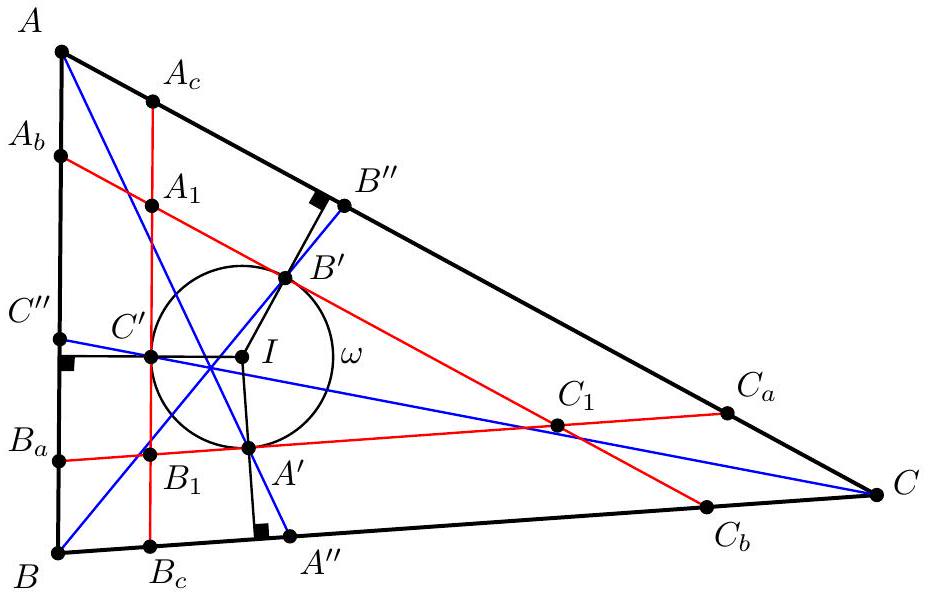
Define A′′A'', B′′B'', C′′C'' to be the intersection points of the lines AA′AA', BB′BB', CC′CC' with the sides BCBC, CACA, ABAB, respectively, BaB_a, CaC_a the intersection points of the tangent line to ω\omega at A′A' with the lines ABAB, ACAC, respectively, CbC_b, AbA_b the intersection points of the tangent line to ω\omega at B′B' with the lines BCBC, BABA, respectively, AcA_c, BcB_c the intersection points of the tangent line to ω\omega at C′C' with the lines CACA, CBCB, respectively, A1A_1, B1B_1, C1C_1 the intersection points of the three tangent lines to ω\omega at A′A', B′B', C′C', as shown in the figure, rr the radius of ω\omega and r0r_0 the inradius of triangle ABCABC.
The distance from A1A_1 to each line ABAB, ACAC is equal to ∣r−r0∣|r - r_0|. Therefore, A1A_1 is on the bisector of angle ∠BAC\angle BAC. But AAbA1AcAA_bA_1A_c is a parallelogram. We deduce that AAbA1AcAA_bA_1A_c is a rhombus and therefore A1Ab=A1AcA_1A_b = A_1A_c. On the other hand, we have A1B′=A1C′A_1B' = A_1C' as tangents to ω\omega from A1A_1. We deduce that AbB′=AcC′A_bB' = A_cC'. We deduce in a similar way that BcC′=BaA′B_cC' = B_aA' and CaA′=CbB′C_aA' = C_bB'.

Figure 1

Because lines BaCaB_aC_a and BCBC are parallel, we have from Thales
BA′′A′′C=BaA′A′Ca. \frac{BA''}{A''C} = \frac{B_aA'}{A'C_a}.
We have similarly
CB′′B′′A=CbB′B′Ab, \frac{CB''}{B''A} = \frac{C_bB'}{B'A_b},
and
AC′′C′′B=AcC′C′Bc. \frac{AC''}{C''B} = \frac{A_cC'}{C'B_c}.
Therefore
BA′′A′′C⋅CB′′B′′A⋅AC′′C′′B=BaA′A′Ca⋅CbB′B′Ab⋅AcC′C′Bc=1, \frac{BA''}{A''C} \cdot \frac{CB''}{B''A} \cdot \frac{AC''}{C''B} = \frac{B_aA'}{A'C_a} \cdot \frac{C_bB'}{B'A_b} \cdot \frac{A_cC'}{C'B_c} = 1,
and by Ceva's theorem, lines AA′AA', BB′BB', CC′CC' are concurrent.

Solution 2

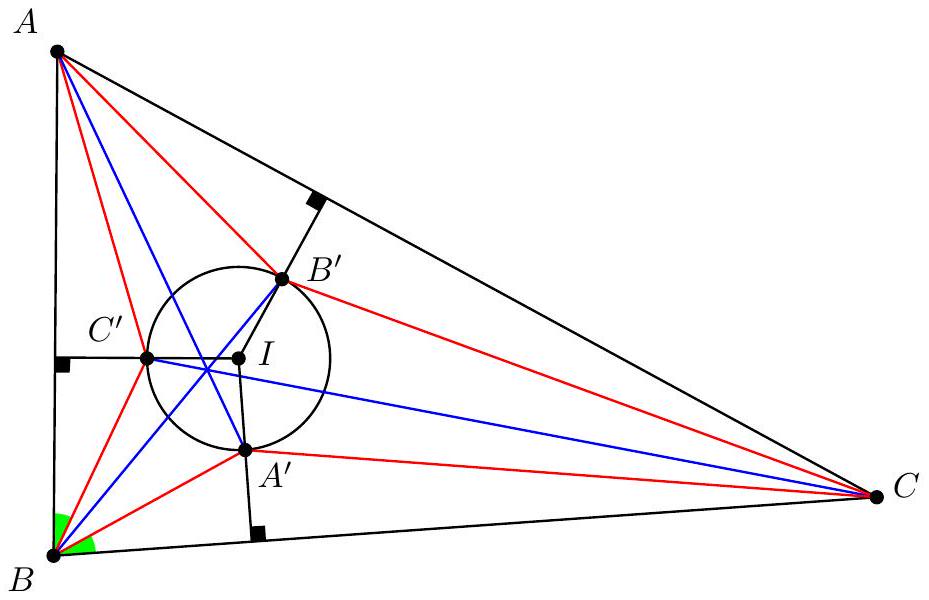
Because IA′IA' and IC′IC' are perpendicular to BCBC and ABAB, respectively, at the intouch points of the incircle of ABCABC, and IA′=IC′IA' = IC', we have ∠CBA′=∠C′BA\angle CBA' = \angle C'BA and ∠A′BA=∠CBC′\angle A'BA = \angle CBC' as oriented angles. We have in a similar way ∠BAC′=∠B′AC\angle BAC' = \angle B'AC, ∠C′AC=∠BAB′\angle C'AC = \angle BAB', ∠ACB′=∠A′CB\angle ACB' = \angle A'CB and ∠B′CB=∠ACA′\angle B'CB = \angle ACA' as oriented angles.
Because AA′AA', BA′BA', CA′CA' intersect in a point A′A', we have from the trigonometric form of Ceva's theorem
sin⁡∠BAA′sin⁡∠A′AC=sin⁡∠A′BAsin⁡∠CBA′⋅sin⁡∠A′CBsin⁡∠ACA′. \frac{\sin \angle BAA'}{\sin \angle A'AC} = \frac{\sin \angle A'BA}{\sin \angle CBA'} \cdot \frac{\sin \angle A'CB}{\sin \angle ACA'}.
Similarly, we have
sin⁡∠CBB′sin⁡∠B′BA=sin⁡∠B′CBsin⁡∠ACB′⋅sin⁡∠B′ACsin⁡∠BAB′, \frac{\sin \angle CBB'}{\sin \angle B'BA} = \frac{\sin \angle B'CB}{\sin \angle ACB'} \cdot \frac{\sin \angle B'AC}{\sin \angle BAB'},
and
sin⁡∠ACC′sin⁡∠C′CB=sin⁡∠C′ACsin⁡∠BAC′⋅sin⁡∠C′BAsin⁡∠CBC′. \frac{\sin \angle ACC'}{\sin \angle C'CB} = \frac{\sin \angle C'AC}{\sin \angle BAC'} \cdot \frac{\sin \angle C'BA}{\sin \angle CBC'}.
Figure 2

After multiplication and cancellation, we obtain
sin⁡∠BAA′sin⁡∠A′AC⋅sin⁡∠CBB′sin⁡∠B′BA⋅sin⁡∠ACC′sin⁡∠C′CB=1. \frac{\sin \angle BAA'}{\sin \angle A'AC} \cdot \frac{\sin \angle CBB'}{\sin \angle B'BA} \cdot \frac{\sin \angle ACC'}{\sin \angle C'CB} = 1.
We deduce from the trigonometric form of Ceva's theorem that AA′AA', BB′BB', CC′CC' are concurrent.

Want a route through all this instead of an archive? The track puts 2,000 problems in a working order, from AMC 10 level to the IMO shortlist.

Source: MathNet, licensed CC-BY-4.0. Statement reproduced verbatim; metadata (topic, difficulty) added by this project.