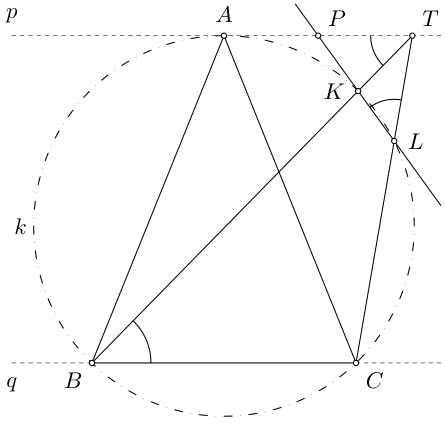
Let p and q be two parallel lines. Circle k touches the line p at A and intersects q at two different points, B and C. Let T be some point on p. Segments TB and TC intersect the shorter arc AC at K and L respectively. Points K and L are both different from B and C. Prove that the line KL passes through the midpoint of the segment AT.
Solution
Let P be the intersection of the lines p and KL. Denote ∠TBC=x. Line BT is a transversal of the parallel lines p and q, which implies that ∠BTA=∠TBC=x. The quadrilateral BCLK is cyclic, hence ∠CLK=180∘−∠KBC=180∘−x, implying ∠KLT=x. Triangles PKT and PTL are similar because they share an angle at P and ∠KTP=∠PLT=x. This implies ∣PT∣∣PK∣=∣PL∣∣PT∣,i.e.∣PK∣⋅∣PL∣=∣PT∣2. Since the power of the point P with respect to the circle k is ∣PK∣⋅∣PL∣=∣PA∣2, we can conclude that ∣PA∣=∣PT∣, i.e. the point P is the midpoint of AT.
Want a route through all this instead of an archive? The track
puts 2,000 problems in a working order, from AMC 10 level to the IMO shortlist.
Source: MathNet,
licensed CC-BY-4.0.
Statement reproduced verbatim; metadata (topic, difficulty) added by this project.