The internal angle bisectors at vertices B and C of triangle ABC intersect the circumcircle of triangle ABC at E and F, respectively. Given that BE=CF=0, may we be sure that triangle ABC is isosceles?
Solutions — 2
Solution 1
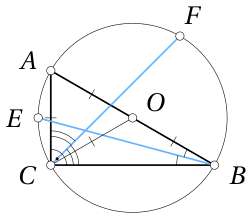
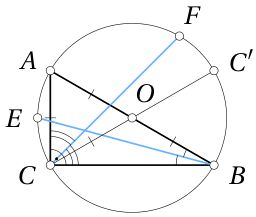
Let ∠ABC=30∘ and ∠BCA=90∘. Let O be the circumcenter of triangle ABC; it is also the midpoint of the hypotenuse AB. We have ∠OAC=∠BAC=60∘, and since AO=CO, it follows that ∠OCA=60∘ (Fig. 30). Therefore, ∠FCO=60∘−290∘=15∘. Let C′ be the reflection of vertex C over the point O (Fig. 31); then ∠FCC′=15∘ as well. On the other hand, ∠ABE=230∘=15∘. In conclusion, we see that the arcs AE and FC′ subtend equal inscribed angles on the circumcircle of triangle ABC, hence the corresponding arcs are equal. Since AB and CC′ are diameters, the remaining arcs BE and CF are also equal. Therefore, the corresponding chords BE=CF are equal. Thus, the equality BE=CF can hold even in a non-isosceles triangle.
Fig. 30 Fig. 31
Solution 2
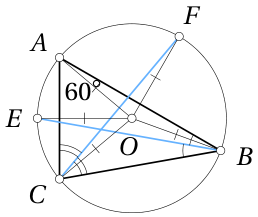
Let ∠CAB=60∘ and AC<AB, and let O be the circumcenter of triangle ABC (Fig. 32). Then ∠BOC=2⋅60∘=120∘. Thus, ∠COE+∠EOA+∠AOF+∠FOB=360∘−120∘=240∘. Since ∠COE=∠EOA and ∠AOF=∠FOB, we have ∠EOA+∠AOF=2240∘=120∘. Consequently, ∠EOF=∠BOC, from which it follows that ∠COF=∠COE+∠EOF=∠BOC+∠COE=∠BOE. In conclusion, we see that the central angles subtended by the shorter arcs BE and CF of the circumcircle of triangle ABC are equal, hence the corresponding arcs are equal. Therefore, the corresponding chords BE and CF are equal. Thus, the equality BE=CF can hold in a non-isosceles triangle.
Fig. 32
Want a route through all this instead of an archive? The track
puts 2,000 problems in a working order, from AMC 10 level to the IMO shortlist.
Source: MathNet,
licensed CC-BY-4.0.
Statement reproduced verbatim; metadata (topic, difficulty) added by this project.