Exactly one integer number is written in each cell of an square table. Per move it is allowed to choose any square, , and either to increase by 1 or to decrease by 1 all numbers in the cells of the chosen square.
Is it possible to get the table with zeros in all its cells from the arbitrary initial table?
(V. Kaskevich)
Solution
We separate the table into five parts: the central square, two rectangles, and two rectangles (see Fig. 1).
We can obtain the 0's in all cells of the rectangles. It suffices to show how we can change (increase by 1 or decrease by 1) the value in any cell of the rectangle so that all other cells of this rectangle keep their value. The corresponding procedures using and squares are shown in Fig. 2 and Fig. 3.
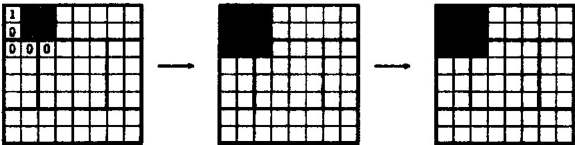
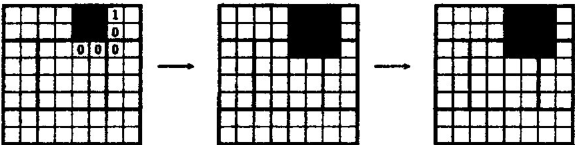
Fig. 3
In similar way we can change (increase by 1 or decrease by 1) the value in any cell of the rectangles. It suffices to show how we can change the value in any cell of these rectangles so that all other cells of these rectangles and all cells of the rectangles keep their value. The corresponding procedures are shown in Fig. 4 (see, in addition, Fig 3).

It remains to change the numbers in the cells of the central square. It suffices to show how we can change the value of any cell of this square so that all other cells of the table keep their value. The corresponding procedures are shown in Fig. 5.

Fig. 5
Want a route through all this instead of an archive? The track
puts 2,000 problems in a working order, from AMC 10 level to the IMO shortlist.