Let be the orthocenter of an acute triangle . Let be the midpoint of . Let and be the reflections of the points and across the point . Prove that the points and and the reflections of over the lines and are concyclic.
Solutions — 2
Solution 1
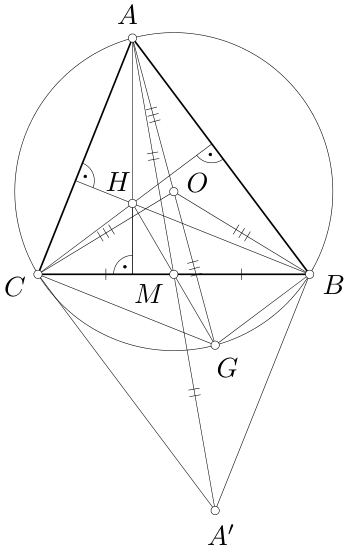
Let be the circumcenter of and the antipode of (Fig. 11). Then and . As and , this means that and . So is a parallelogram. Therefore , the midpoint of , is also the midpoint of . Consequently . Hence and . Also, by the choice of , is a parallelogram, meaning and . Thus and , which means that the reflections of over the lines and lie on lines and respectively; denote them by and (Fig. 12). Then and , analogously also and . Therefore and are isosceles trapezoids. Isosceles trapezoids are cyclic quadrilaterals, thus both and must lie on the circumcircle of . The desired claim follows.
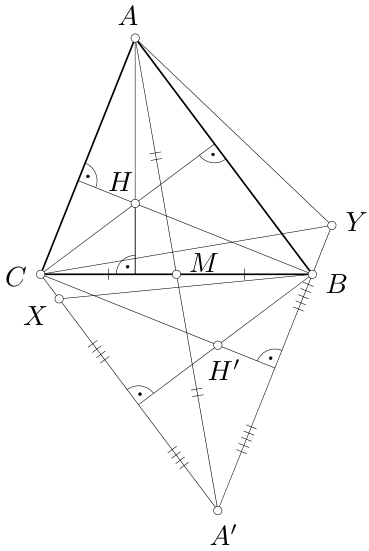
Solution 2
Like in the previous solution, notice that is a parallelogram. By symmetry with respect to notice that triangles and are congruent and that is the orthocenter of .
Let and be the reflections of over and respectively (Fig. 13). Then and and since is the orthocenter of , we also have and . So and lie on the lines and respectively.
The choice of and implies that the triangles and are isosceles. Therefore . The desired claim follows.
Want a route through all this instead of an archive? The track
puts 2,000 problems in a working order, from AMC 10 level to the IMO shortlist.