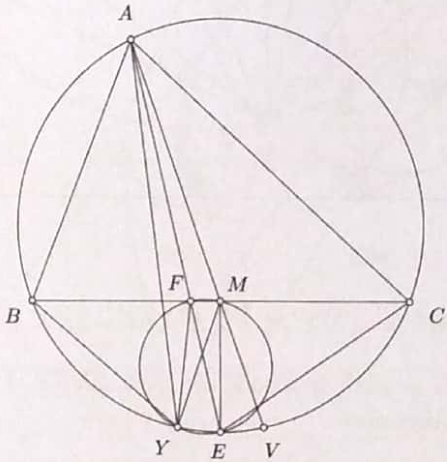
Let ABC be a triangle and let ω be its circumcircle. Let E be the midpoint of the minor arc BC of ω, and M the midpoint of BC. Let V be the other point of intersection of AM with ω, F the point of intersection of AE with BC, X the other point of intersection of the circumcircle of FEM with ω, X′ the reflection of V with respect to M, A′ the foot of the perpendicular from A to BC and S the other point of intersection of XA′ with ω. If Z∈ω with Z=X is such that AX=AZ, then prove that S, X′ and Z are collinear.
Solution
Claim 1.AX is the A-symmedian of △ABC. Proof of Claim 1. Let Y∈ω such that AY is the A-symmedian of triangle ABC. We want to prove that Y=X. We have that ∠BAY=∠CAM and ∠BYA=∠BCA=∠MCA, therefore the triangles ABY and AMC are similar. It follows that (AY)(AM)=(AB)(AC). Since AE is the bisector of ∠BAC, then ∠BAF=∠CAE. We also have ∠ABF=∠ABC=∠AEC, therefore the triangles BAF and EAC are similar. It follows that (AE)(AF)=(AB)(AC). We get (AY)(AM)=(AE)(AF) and since also ∠YAF=∠EAM, then the triangles YAF and EAM are similar. So ∠AFY=∠AME and ∠YFE=∠EMV. But as E is the midpoint of the arc YV, it follows that ∠EMV=∠YME. So ∠YFE=∠YME from which it follows that the quadrilateral YFME is cyclic. But since Y∈ω, we finally get that Y=X. □ From Claim 1 we conclude that the triangles XBC and VCB are equal. Thus MX=MV=MX′. So the triangle X′XV is a right-angled triangle and X′X is perpendicular to XV and therefore also to BC. Thus X′ is the reflection of X on BC. Claim 2. The quadrilateral ASA′M is cyclic. Proof of Claim 2. We have ∠ASA′=∠ASX=∠ABX. But from Claim 1 we also have ∠ABX=∠AMC. So ∠ASA′=∠AMC and the result follows. □ Claim 3. The quadrilateral XSX′M is cyclic. Proof of Claim 3. From Claim 2 we have ∠XSM=∠A′SM=∠A′AM. Since XX′ is parallel to AA′ we have ∠A′AM=∠XX′M. So ∠XSM=∠XX′M and the result follows. □
Now from Claim 3 we have ∠XSX′=∠XMV=∠XX′M+∠X′XM=2∠XX′M=2∠AA′M. So to conclude the proof it is enough to also show that ∠XSZ=2∠AA′M. From Claim 1 we have ∠ACX=∠MAB and therefore ∠AZX=∠ACX=∠AMB=90∘−∠A′AM. Since the triangle XAZ is isosceles, we deduce that ∠XSZ=∠XAZ=180∘−2∠AZX=2∠A′AM thus completing the proof.
Want a route through all this instead of an archive? The track
puts 2,000 problems in a working order, from AMC 10 level to the IMO shortlist.
Source: MathNet,
licensed CC-BY-4.0.
Statement reproduced verbatim; metadata (topic, difficulty) added by this project.